
Interview with Danial Kooshki, Bassist of Khardal, about the Album ‘Reverse Silence’
By Kazem Kalantari – Milan Weekly
“The Silent Voice of Funk Music”
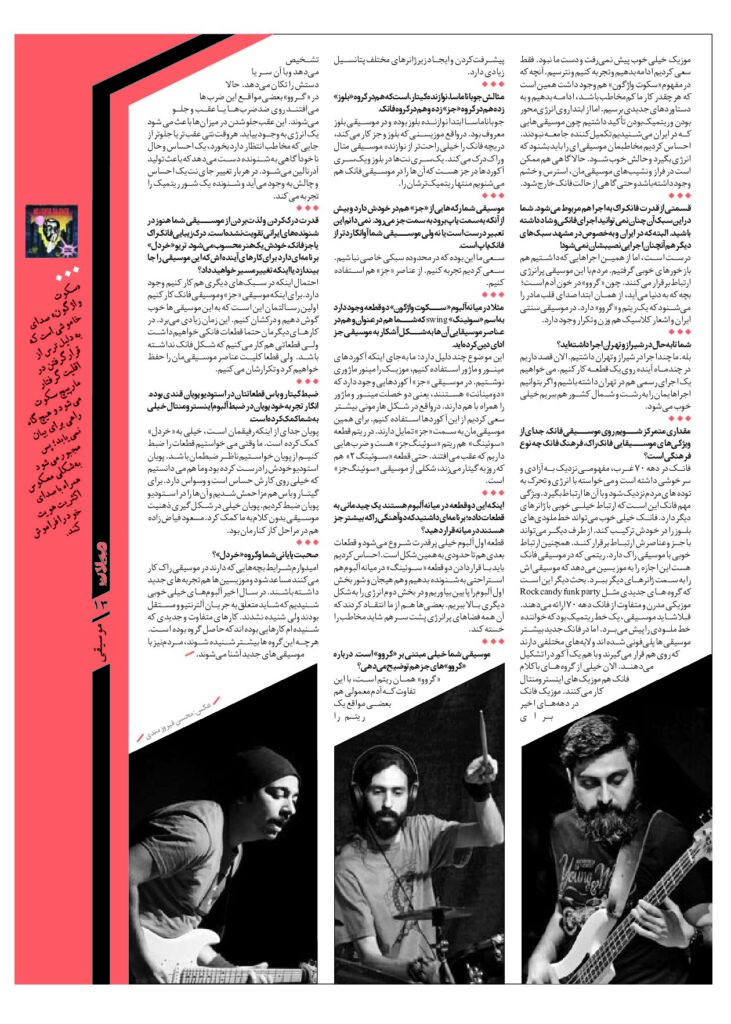
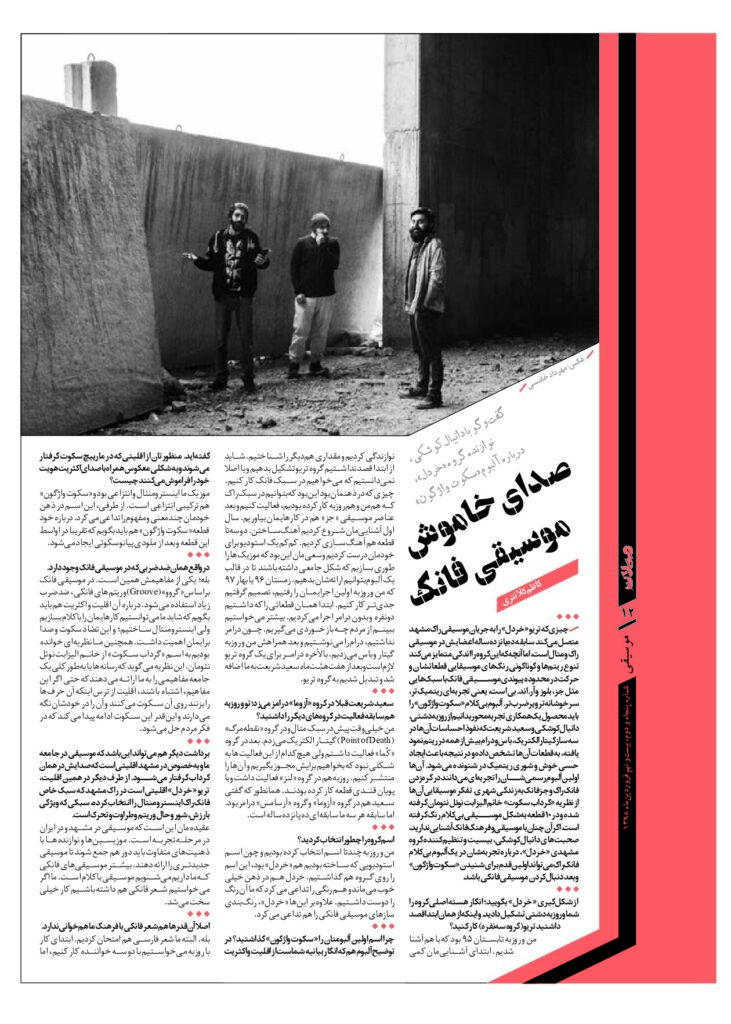
What connects the trio “Khardal” to Mashhad’s rock music scene is the fifteen-year background of its members in rock and metal.
What makes this group somewhat distinct, however, is the variety of rhythms and the diversity of musical colors in their pieces,
and their movement within the hybrid zone linking funk with styles such as jazz, blues, and R&B — meaning a more rhythmic,
playful, and high-energy experience. The instrumental album “Reverse Silence” should be regarded as the product of an
experience-driven collaboration between Roozbeh Dashti, Danial Kooshki, and Saeid Shariat, whose emotions in the three instruments —
electric guitar, bass, and drums — are expressed most vividly through rhythm. This has given their pieces identity and created a
sense of joy and rhythmic excitement in the listener. They consider their first official album as experiments in connecting funk rock
and jazz funk to urban life. Their musical thinking was inspired by Elisabeth Noelle-Neumann’s theory of the “Spiral of Silence,”
embodied in ten instrumental tracks. If you are not yet familiar with funk music and its culture, the words of Danial Kooshki,
bassist and arranger of the Mashhad-based group Khardal, about their experience in creating an instrumental funk-rock album,
can serve as the first step to listening to “Reverse Silence” and then following funk music itself.
— Tell us about the formation of Khardal; it seems you and Roozbeh Dashti formed the core of the group. Did you intend from the
start to work as a trio?
— Roozbeh and I met in the summer of 2016. At first, we jammed a bit and got to know each other. Perhaps from the beginning we
did not intend to form a trio, nor did we even know we wanted to play funk. What was in our minds was that we could continue working
in rock, where both of us already had experience, and then bring jazz elements into our work. In our first year together we began
writing music. We composed two or three pieces, gradually built a small studio, and tried to make our music cohesive enough to
present as an album. In winter 2017 or spring 2018, when Roozbeh and I gave our first performance, we decided to get more serious.
We initially performed the pieces we had as a duo, without a drummer, mostly to see how people would react. Since we didn’t have a
drummer, we programmed the drums and played guitar and bass along with them. Eventually, a trio needs a drummer, and after
seven or eight months later, Saeid Shariat joined us and we became a trio.
— Saeid Shariat had previously played drums in the group “Azoma.” You and Roozbeh had also been active in other bands?
— A long time ago, I used to play electric guitar in the metal band “Point of Death.” Later I was active in the group “Koma,”
but none of these projects were official or released with permits. Roozbeh had played in the band “Lens” and had worked with
Pooyan Ghandi on some tracks. As you said, Saeid had been drummer in “Azoma” and in the band “Arsames.” Altogether, the three of us
had around fifteen years of experience.
— How did you choose the name of the group?
— Roozbeh and I had several names in mind, and since the name of the studio we had built was also “Khardal,” we used it for the band.
Khardal stuck well in people’s minds and evoked a color we liked. Beyond that, “Khardal” also reflected the colorful palette
associated with funk instrumentation.
— Why did you name your first album “Reverse Silence”?
— In your album notes, almost like a manifesto, you wrote about minorities and majorities. What did you mean by minorities who,
trapped in the spiral of silence, forget their identity by aligning inversely with the voice of the majority? Our music was
instrumental and abstract, and “Reverse Silence” was itself an abstract phrase. On another level, it evoked several different
meanings for us. Regarding the track “Reverse Silence,” I can say that midway through the piece, after a piano melody, there is a
moment of silence.
— In fact, like the syncopation present in funk music?
Yes; one of its concepts is exactly that. Funk music, built on groove and funky rhythms, often uses syncopation. Regarding
minorities and majorities, I should also say that we might have composed with vocals, but we chose to create instrumental music.
This contrast between silence and sound was important to us. Moreover, we had read a theory called the “Spiral of Silence” by
Elisabeth Noelle-Neumann. This theory says that media, or society at large, imposes concepts on us that—even if mistaken—minorities,
fearing to voice their disagreement, remain silent, internalize them, and after long enough this silence dissolves into public thought.
— Another interpretation could be that music in our society, particularly in Mashhad, is itself a minority whose voice gets trapped
in the same spiral. Within that minority, Khardal is itself a minority in Mashhad’s rock scene, choosing the niche style of
instrumental funk rock, whose key features are vitality, rhythm, freshness, and movement. I believe music in Mashhad and in Iran is
still in an experimental phase. Musicians with diverse mindsets must come together to present newer forms of music. Most of the
funk we hear is vocal funk. If we wanted to add funk lyrics, it would have been very difficult.
— Indeed, funk lyrics do not fit our culture very well.
Yes. We even tried using Persian poetry at first. Roozbeh and I wanted to work with two or three singers, but the music itself
progressed so well that it was beyond our control. We simply tried to continue, to experiment, and not to be afraid. What lies at
the heart of “Reverse Silence” is exactly this: the more we push forward, the more the audience continues with us and we achieve
new outcomes. From the start we emphasized energy and rhythm, because the music we heard in Iran did not fulfill society’s needs.
We felt our listeners should hear music that gives them energy and uplifts them. Sometimes, of course, in our ups and downs there
is also stress and anger, and at times the music may move outside of funk.
— Part of funk rock’s power also lies in performance. But in Iran, especially in Mashhad, this style rarely gets live stages,
just like other genres.
That’s true. Still, the few performances we had received very good reactions. People connect with this energetic music. Groove is
in our blood. A baby, from the moment it is born, hears the mother’s heartbeat — a groove. Even in Persian classical music and
poetry, rhythm and repetition exist.
— Have you performed in Shiraz and Tehran so far?
Yes. We have given several performances in Shiraz and Tehran. Right now we plan to work on a new track in the coming months. We
want to have an official performance in Tehran, and if we can take our shows to Rasht and northern Iran, that would be great.
— Let’s focus more on funk itself. Beyond the features of funk rock, what kind of culture does funk represent?
— In the West of the 1970s, funk symbolized freedom and joy. It sought to connect with the masses through energy and movement.
A major quality of funk is that it interacts very well with other genres. Funk can absorb blues melodic lines. It can also connect
with jazz and its elements. Likewise, it links strongly with rock. Funk’s rhythmic nature allows musicians to push their music
towards other genres. Another point is that new groups such as Rock Candy Funk Party now present music that is modern and
different from 1970s funk. Previously, music was often a single melodic line with a singer carrying it. But in modern funk,
music has become more polyphonic, with multiple lines layered together forming a chord. Today, even many vocal funk groups also
compose instrumental music. Funk in recent decades has had huge potential to evolve and create subgenres.
— For example, Joe Bonamassa, the guitarist, who has played in blues, jazz, and funk groups.
— Joe Bonamassa began as a blues guitarist and became famous in that scene. A musician working in blues and jazz can grasp funk
much more easily than someone from metal or rock. The missing notes in blues and certain chords in jazz are also heard in funk,
though with funk’s rhythmic emphasis.
— Your music also contains traces of jazz, and it leans more towards jazz than pop. Would you say your music is more avant-garde
than funk or pop?
— We tried not to be confined within a strict genre. We experimented and used jazz elements as well.
— For example, in the middle of “Reverse Silence” there are two tracks called “Swing,” in which you explicitly paid homage to jazz.
— There are several reasons for that. Instead of writing strictly in minor or major keys, we wrote in minor-major tonality. In jazz,
there are “dominant” chords that carry both minor and major qualities simultaneously. We drew more on such chords in our harmony.
That’s why our music leans towards jazz. In rhythm too, the swing rhythm belongs to jazz, with beats that lag behind. Even in the
second “Swing” track, where Roozbeh plays guitar, it is shaped by jazz swing.
— Placing those two tracks in the middle gave a structure to the album; did you intentionally put the more jazz-oriented pieces
there?
— The first track of the album starts very powerfully, and the following tracks continue with similar intensity. We felt that by
placing the two swing tracks in the middle, we could give listeners a rest and reduce the initial rush, then rebuild energy in a
different way in the second half. Some even criticized us, saying too many high-energy tracks in a row might tire listeners.
— Your music is heavily based on “groove.” Can you explain groove for us, especially in jazz?
— Groove is rhythm, with the difference that even a non-musician can feel it and start moving their head or hands. In groove,
sometimes the beats fall on off-beats or move slightly behind or ahead. This displacement creates energy. Every time a note comes
earlier or later than expected, it creates an unconscious feeling in the listener, releasing adrenaline. Each variation produces a
sense of challenge and rhythmic excitement.
— Many Iranian listeners are not yet accustomed to perceiving and enjoying funk rock or jazz funk. Does Khardal plan to
popularize this style or will you change direction?
— There is always a chance we will work in other styles too. But for jazz and funk, our first mission is to listen deeply and
understand them. That takes time. In our other works, we will certainly have funk tracks, but also pieces that are not funk.
Still, we will definitely preserve and repeat the core elements of our sound.
— You recorded the guitars and bass for your tracks at Pooyan Ghandi’s studio. Did his experience with instrumental albums help?
— Pooyan is not only a close friend, but also helped Khardal enormously. When we wanted to record, we asked him to supervise.
He had built his own studio and we knew he was meticulous about sound. For the guitars and bass, we worked with him at his studio.
Pooyan Khalili helped shape our instrumental mindset. Masoud Fayaz Zadeh also assisted us at stages of the work.
— Final thoughts from you and the band?
— I hope the situation for young musicians in rock improves, and that they all gain new experiences. In the past year I’ve heard
excellent albums that belonged to the alternative and independent scene but went unnoticed. The works that struck me as most
interesting were those born of collaboration in groups. The more these bands are heard, the more the public will be exposed to new music.
Footnote:
“Reverse Silence” is the muted voice that, out of fear of being a minority, becomes trapped in the spiral of silence and never
finds a way to speak; it is thus forced, inversely, to merge with the voice of the majority and forget its own identity.
You Can download the PDF file On Milan Weekly Archives from this Link